Film · 2001 · Films · 2000s
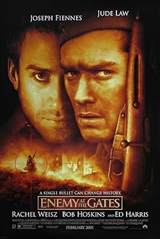
Enemy at the Gates
Scored from 455 calibrated IMDb reviewers. Cohort: Films · 2000s (7,847 peers).
Summary
During the Battle of Stalingrad in World War II, Russian sniper Vassili Zaitsev emerges as a symbol of Soviet resistance. His string of successful kills attracts the attention of a German sniper, Major Erwin König, leading to a deadly duel between the two marksmen amid the devastation of the battlefield.
Enemy at the Gates is a 2001 war, drama and thriller film directed by Jean-Jacques Annaud. Its country of origin is listed as Germany. Its certificate is R. Jude Law, Ed Harris and Rachel Weisz head the billed cast. It runs 2h 11m.
Its in-cohort standing is measured against the other 7,846 2000s films, not against the whole corpus. Rotten Tomatoes carries a separate audience for the same title, 5,641 of whom clear the calibration test. The calibrated figure is built from 455 of its IMDb reviewers. A broader pool of 474 reviewers with two or more reviews feeds the raw-average track instead.
Is Enemy at the Gates (2001) worth watching?
- Cohort
- Films · 2000s · 7,847 titles
- Calibrated reviewers
- 455
Cohort: Films · 2000s