Film · 2018 · Films · 2010s
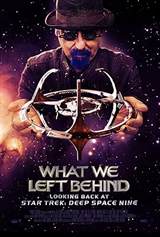
What We Left Behind: Looking Back at Star Trek: Deep Space Nine
Scored from 59 calibrated IMDb reviewers, each re-centered on their own rating baseline before the title is ranked. Cohort: Films · 2010s (13,059 peers).
Summary
Twenty years after Star Trek: Deep Space Nine ended, showrunner Ira Steven Behr gathers its cast and writing staff to ask why the franchise's darkest and most serialised entry was for so long its least loved. Avery Brooks, Nana Visitor, Armin Shimerman, Rene Auberjonois and Alexander Siddig revisit the station, the Dominion War, and storylines that broke Gene Roddenberry's rule against conflict among Starfleet officers. As a framing device, Behr reconvenes writers including Ronald D. Moore and Robert Hewitt Wolfe in a room to break the story for a hypothetical eighth-season premiere. The crowdfunded documentary, co-directed by Behr and David Zappone, also presents newly remastered high-definition footage from the series.
Released in 2018, What We Left Behind: Looking Back at Star Trek: Deep Space Nine is a documentary and science-fiction film. Its country of origin is listed as the United States. It runs 1h 53m.
Its in-cohort standing is measured against the other 13,058 2010s films, not against the whole corpus. Rotten Tomatoes carries a separate audience for the same title, 6 of whom clear the calibration test. Only 59 of its IMDb reviewers rate with enough spread for a personal baseline to be measured, so the calibrated figure rests on a thin sample; a broader pool of 63 reviewers with at least two reviews feeds the raw-average track.
How the score was built
We compare the reviewers of this title against every other title those same people reviewed. Each review is scored relative to the reviewer's own baseline — a 7/10 from a hard grader sits well above their average, while a 7/10 from a generous grader sits below theirs. Every reviewer then counts the same, so the result is a calibrated consensus rather than a raw average.
- Global percentile
- Where What We Left Behind: Looking Back at Star Trek: Deep Space Nine lands against every title we rank.
- In-cohort percentile
- The same comparison narrowed to its cohort — titles of the same format released in the same decade. A 1970s film is judged against 1970s films, not against last year's streaming series. Ranked against Films · 2010s (13,059 titles).
- AI-adjusted percentile
- The same reviewer-normalized score, corrected for how much confidence the sample supports: thin samples are pulled toward the corpus average. Each title keeps the share n / (n + 53) of its measured distance from the average, where n is its calibrated-reviewer count, and the result is ranked on the same scale as the global percentile.53 is the median sample size across everything we rank. Here n is 59.
Cohort: Films · 2010s