Film · 2016 · Films · 2010s
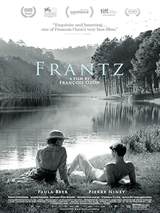
Frantz
Scored from 73 calibrated IMDb reviewers, each re-centered on their own rating baseline before the title is ranked. Cohort: Films · 2010s (13,059 peers).
Summary
François Ozon's largely black-and-white period drama opens in a small German town in 1919, where Anna (Paula Beer) lives with the parents of her fiancé Frantz Hoffmeister, killed in the war. She finds a young Frenchman, Adrien Rivoire (Pierre Niney), laying flowers at Frantz's grave; he says he knew Frantz in Paris before the war, and the grieving Dr. Hoffmeister and his wife gradually take him in as a link to their son. The town's veterans resent a Frenchman at a German table, and Adrien's account of the friendship does not entirely hold together. The second half moves to France as Anna follows the question herself. Loosely derived from Maurice Rostand's play and Lubitsch's Broken Lullaby.
Frantz is a 2016 drama, history and romance film. It was made in France, in French. Its certificate is PG-13. It runs 1h 53m.
Rotten Tomatoes carries a separate audience for the same title, 47 of whom clear the calibration test. Only 73 of its IMDb reviewers rate with enough spread for a personal baseline to be measured, so the calibrated figure rests on a thin sample; a broader pool of 74 reviewers with at least two reviews feeds the raw-average track. Its in-cohort standing is measured against the other 13,058 2010s films, not against the whole corpus.
How the score was built
We compare the reviewers of this title against every other title those same people reviewed. Each review is scored relative to the reviewer's own baseline — a 7/10 from a hard grader sits well above their average, while a 7/10 from a generous grader sits below theirs. Every reviewer then counts the same, so the result is a calibrated consensus rather than a raw average.
- Global percentile
- Where Frantz lands against every title we rank.
- In-cohort percentile
- The same comparison narrowed to its cohort — titles of the same format released in the same decade. A 1970s film is judged against 1970s films, not against last year's streaming series. Ranked against Films · 2010s (13,059 titles).
- AI-adjusted percentile
- The same reviewer-normalized score, corrected for how much confidence the sample supports: thin samples are pulled toward the corpus average. Each title keeps the share n / (n + 53) of its measured distance from the average, where n is its calibrated-reviewer count, and the result is ranked on the same scale as the global percentile.53 is the median sample size across everything we rank. Here n is 73.
Cohort: Films · 2010s