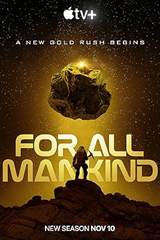
TV Series · 2019 · TV Series · 2010s
For All Mankind
Scored from 640 calibrated IMDb reviewers. Cohort: TV Series · 2010s (3,236 peers).
Summary
In an alternate history, the Soviet Union beats the United States to the moon in 1969. The series explores how this dramatic divergence reshapes the space race, Cold War geopolitics, and the lives of NASA astronauts, test pilots, and their families across multiple decades.
For All Mankind is a 2019 drama and science fiction television series starring Josh O'Connor, Michael Dorman and Wrenn Schmidt. Episodes run about 50m. Ronald D. Moore created it. Its certificate is TV-MA. Its country of origin is listed as the United States.
The calibrated figure is built from 640 of its IMDb reviewers. A broader pool of 676 reviewers with two or more reviews feeds the raw-average track instead. Its in-cohort standing is measured against the other 3,235 2010s television series, not against the whole corpus. Rotten Tomatoes carries a separate audience for the same title, 360 of whom clear the calibration test.
Is For All Mankind (2019) worth watching?
- Cohort
- TV Series · 2010s · 3,236 titles
- Calibrated reviewers
- 640
Cohort: TV Series · 2010s