Film · 2014 · Films · 2010s
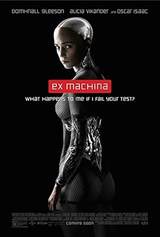
Ex Machina
Scored from 1,016 calibrated IMDb reviewers. Cohort: Films · 2010s (13,059 peers).
Summary
A young programmer is invited to a remote research facility to conduct an artificial intelligence test on Ava, an advanced humanoid robot created by the facility's reclusive founder. As Caleb administers a series of tests to determine if Ava possesses true consciousness, he becomes increasingly fascinated by the AI and questions the true nature of the experiment.
Ex Machina is a 2014 science fiction, thriller and drama film starring Domhnall Gleeson, Alicia Vikander and Oscar Isaac. Its certificate is R. Its country of origin is listed as the United Kingdom. Alex Garland directed it. It runs 1h 50m.
The cohort it is ranked inside is 2010s films — 13,059 of them. The calibrated figure is built from 1,016 of its IMDb reviewers. A broader pool of 1,041 reviewers with two or more reviews feeds the raw-average track instead. Rotten Tomatoes carries a separate audience for the same title, 3,785 of whom clear the calibration test.
Is Ex Machina (2014) worth watching?
- Cohort
- Films · 2010s · 13,059 titles
- Calibrated reviewers
- 1,016
Cohort: Films · 2010s