Film · 1989 · Films · 1980s
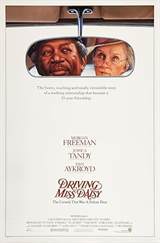
Driving Miss Daisy
Scored from 193 calibrated IMDb reviewers, each re-centered on their own rating baseline before the title is ranked. Cohort: Films · 1980s (3,141 peers).
Summary
In 1948 Atlanta, a wealthy elderly Jewish widow reluctantly accepts a Black chauffeur hired by her son after she can no longer drive safely. Over the following 25 years, the prickly Miss Daisy and her patient driver Hoke develop a deep, unlikely friendship against the backdrop of the changing American South and the civil rights movement.
Released in 1989, Driving Miss Daisy is a comedy and drama film. Inside comedy it is classed as Dramedy.
Rotten Tomatoes carries a separate audience for the same title, 1,562 of whom clear the calibration test. The calibrated figure is built from 193 reviewers whose rating history varies enough to place their own average. A broader pool of 196 reviewers with two or more reviews feeds the raw-average track instead. Its in-cohort standing is measured against the other 3,140 1980s films, not against the whole corpus.
How the score was built
We compare the reviewers of this title against every other title those same people reviewed. Each review is scored relative to the reviewer's own baseline — a 7/10 from a hard grader sits well above their average, while a 7/10 from a generous grader sits below theirs. Every reviewer then counts the same, so the result is a calibrated consensus rather than a raw average.
- Global percentile
- Where Driving Miss Daisy lands against every title we rank.
- In-cohort percentile
- The same comparison narrowed to its cohort — titles of the same format released in the same decade. A 1970s film is judged against 1970s films, not against last year's streaming series. Ranked against Films · 1980s (3,141 titles).
- AI-adjusted percentile
- The same reviewer-normalized score, corrected for how much confidence the sample supports: thin samples are pulled toward the corpus average. Each title keeps the share n / (n + 53) of its measured distance from the average, where n is its calibrated-reviewer count, and the result is ranked on the same scale as the global percentile.53 is the median sample size across everything we rank. Here n is 193.
Cohort: Films · 1980s