Film · 1962 · Films · 1960s
Days of Wine and Roses
Scored from 117 calibrated IMDb reviewers, each re-centered on their own rating baseline before the title is ranked. Cohort: Films · 1960s (1,929 peers).
Summary
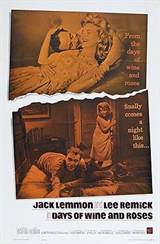
Blake Edwards directs this drama about Joe Clay, a San Francisco public relations man who drinks his way through client work and courts Kirsten Arnesen, a client's secretary who prefers chocolate to liquor. He introduces her to brandy Alexanders; she takes to drinking as readily as he does, and their marriage, his career and their care of their young daughter erode as both slide into alcoholism. Kirsten's plain-spoken nurseryman father watches the decline, and Alcoholics Anonymous eventually offers Joe a way to count days sober. Adapted by J.P. Miller from his own television play, it stars Jack Lemmon and Lee Remick.
Days of Wine and Roses is a 1962 drama film. Its country of origin is listed as the United States. Its certificate is Approved. It runs 1h 57m.
The cohort it is ranked inside is 1960s films — 1,929 of them. The calibrated figure is built from 117 reviewers whose rating history varies enough to place their own average. A broader pool of 118 reviewers with two or more reviews feeds the raw-average track instead.
How the score was built
We compare the reviewers of this title against every other title those same people reviewed. Each review is scored relative to the reviewer's own baseline — a 7/10 from a hard grader sits well above their average, while a 7/10 from a generous grader sits below theirs. Every reviewer then counts the same, so the result is a calibrated consensus rather than a raw average.
- Global percentile
- Where Days of Wine and Roses lands against every title we rank.
- In-cohort percentile
- The same comparison narrowed to its cohort — titles of the same format released in the same decade. A 1970s film is judged against 1970s films, not against last year's streaming series. Ranked against Films · 1960s (1,929 titles).
- AI-adjusted percentile
- The same reviewer-normalized score, corrected for how much confidence the sample supports: thin samples are pulled toward the corpus average. Each title keeps the share n / (n + 53) of its measured distance from the average, where n is its calibrated-reviewer count, and the result is ranked on the same scale as the global percentile.53 is the median sample size across everything we rank. Here n is 117.
Cohort: Films · 1960s