Film · 1984 · Films · 1980s
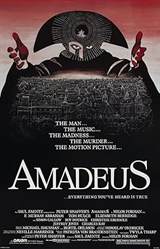
Amadeus
Scored from 594 calibrated IMDb reviewers. Cohort: Films · 1980s (3,141 peers).
Summary
In 18th-century Vienna, court composer Antonio Salieri becomes consumed with jealousy upon encountering the prodigious Wolfgang Amadeus Mozart. As Mozart's unparalleled genius threatens Salieri's own legacy, his envy spirals into a bitter obsession to destroy the younger composer. The film explores the tension between talent, mediocrity, and ambition in the world of classical music.
Released in 1984, Amadeus is a drama, biography and music film. Its certificate is PG. It runs 2h 40m. Its country of origin is listed as Austria and the United States. Miloš Forman directed it, with F. Murray Abraham, Tom Hulce and Elizabeth Berridge in the cast.
Rotten Tomatoes carries a separate audience for the same title, 6,858 of whom clear the calibration test. Its in-cohort standing is measured against the other 3,140 1980s films, not against the whole corpus. The calibrated figure is built from 594 of its IMDb reviewers. A broader pool of 629 reviewers with two or more reviews feeds the raw-average track instead.
Is Amadeus (1984) worth watching?
- Cohort
- Films · 1980s · 3,141 titles
- Calibrated reviewers
- 594
Cohort: Films · 1980s