Book · Linda Ward Beech · 2010
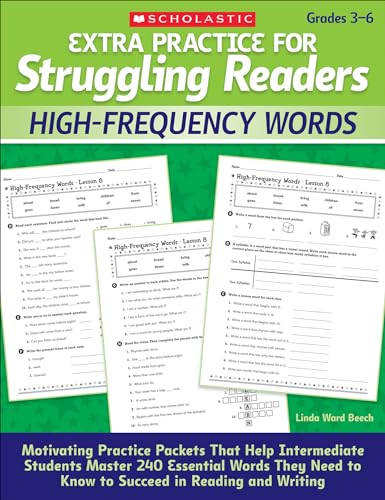
Extra Practice for Struggling Readers: High-Frequency Words: Motivating Practice Packets That Help Intermediate Students Master 240 Essential Words They Need to Know to Succeed in Reading and Writing
Scored from 3 calibrated reviewers, each re-centered on their own rating baseline before the book is ranked. Cohort: 2010s books (1,613 books).
Summary
Extra Practice for Struggling Readers: High-Frequency Words: Motivating Practice Packets That Help Intermediate Students Master 240 Essential Words They Need to Know to Succeed in Reading and Writing is a 2010 title shelved for adult readers. It is credited to Linda Ward Beech.
The calibrated sample is 3 reviewers — the ones whose rating history varies enough to place their own average — out of 7 who rated it at least twice. The sample-size-adjusted percentile pulls a sample that thin toward the corpus average. The cohort it is ranked inside is the 2010s, 1,613 books wide.
How the score was built
We compare the reviewers of this book against every other book those same people reviewed. Each rating is scored relative to the reviewer's own baseline, so a reader who gives everything five stars is measured against their own five-star habit rather than against a stranger's. Every reviewer then counts the same, so the result is a calibrated consensus rather than a star average.
- Global percentile
- Where Extra Practice for Struggling Readers: High-Frequency Words: Motivating Practice Packets That Help Intermediate Students Master 240 Essential Words They Need to Know to Succeed in Reading and Writing lands against every book we rank.
- In-cohort percentile
- The same comparison narrowed to its cohort — books published in the same decade, so a Victorian novel is judged against Victorian novels rather than against this year's releases. Ranked against 2010s books (1,613 books).
- AI-adjusted percentile
- The same reviewer-normalized score, corrected for how much confidence the sample supports: thin samples are pulled toward the corpus average. Each book keeps the share n / (n + 53) of its measured distance from the average, where n is its calibrated-reviewer count, and the result is ranked on the same scale as the global percentile.53 is the median sample size across everything we rank. Here n is 3.
Similar percentile