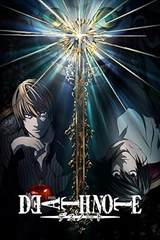
TV Series · 2006 · TV Series · 2000s
Death Note
Scored from 617 calibrated IMDb reviewers. Cohort: TV Series · 2000s (1,360 peers).
Summary
High school student Light Yagami discovers a supernatural notebook that grants him the power to kill anyone by writing their name in it. He uses this power to eliminate criminals and reshape society according to his ideals, while a mysterious detective known only as L works to identify and stop him.
Death Note is a 2006 thriller, mystery and supernatural television series starring Mamoru Miyano, Kappei Yamaguchi and Haruka Terui. Episodes run about 24m. It was made in Japan. Tsugumi Ohba and Takeshi Obata created it. Its certificate is TV-14. It plays in Japanese.
Rotten Tomatoes carries a separate audience for the same title, 74 of whom clear the calibration test. 1,359 other television series from the 2000s form the cohort it is ranked inside. The calibrated figure is built from 617 of its IMDb reviewers. A broader pool of 704 reviewers with two or more reviews feeds the raw-average track instead.
Is Death Note (2006) worth watching?
- Cohort
- TV Series · 2000s · 1,360 titles
- Calibrated reviewers
- 617
Cohort: TV Series · 2000s